


The Scoop New York is a non-profit website and newsletter covering the movement for a true no-kill New York, from BUF to BK. NYC ACC KILLS, published by TSNY, enumerates and memorializes adoptable cats and dogs who were exterminated by Animal Care Centers of New York City.
The Scoop New York is the only news outlet to consider newsworthy taxpayer-funded cruelty toward homeless companion animals, as well as decades of officials’ deliberate abuse — psychological, physical and financial — of the New Yorkers who care about them.
Tax-deductible donations and paid subscriptions make it possible for The Scoop New York to investigate and expose kill-pound corruption statewide. Tap or click here to donate or subscribe. Thank you.

Headlines from Buffalo to Brooklyn
It’s June 27, 2026. This is The Weekly Poop.
This week, we back up.
Let’s get to it.
The New York State Department of Agriculture and Markets last month conducted an inspection of Animal Care Centers of New York City [sic].
The visit came five six months after new statewide shelter standards took effect. The regs were approved by lawmakers in 2022 as the Companion Animal Care Standards Act. By not enforcing them until last December, the idea was to give shelters and rescues time to comply.
To the surprise of no one who’s paying attention, the three-year grace period was not enough for ACC and its DOH overseers to get it together.
Of 50 applicable requirements, ACC failed to meet 19. Meaning if the state assigned shelters a letter grade, absentee Mayor Zohran Mamdani’s kill pound would’ve scored a D- at best.

It gets worse.
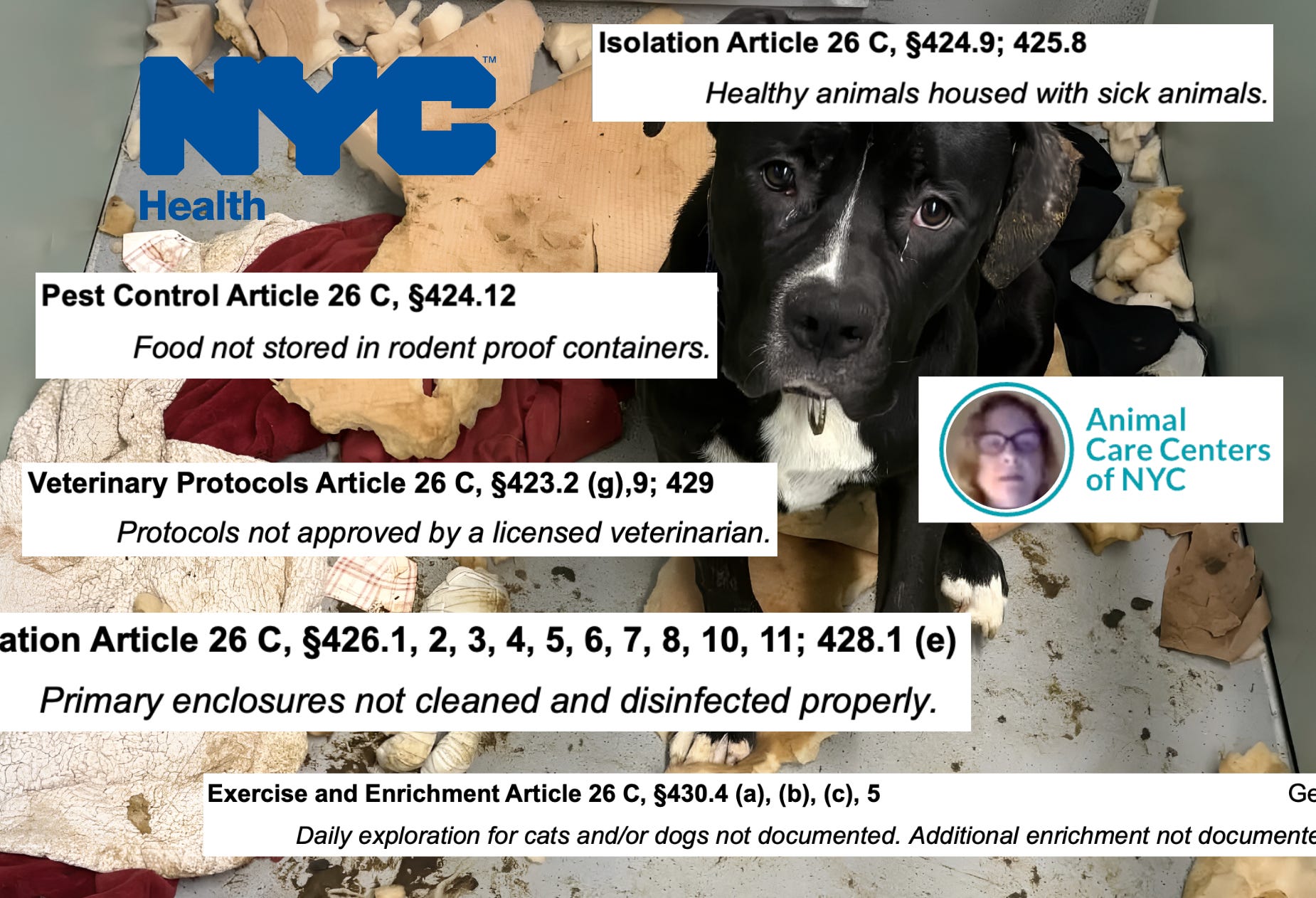
Of the 19 failure points, five were considered “critical” deficiencies. Let’s take it from the top.
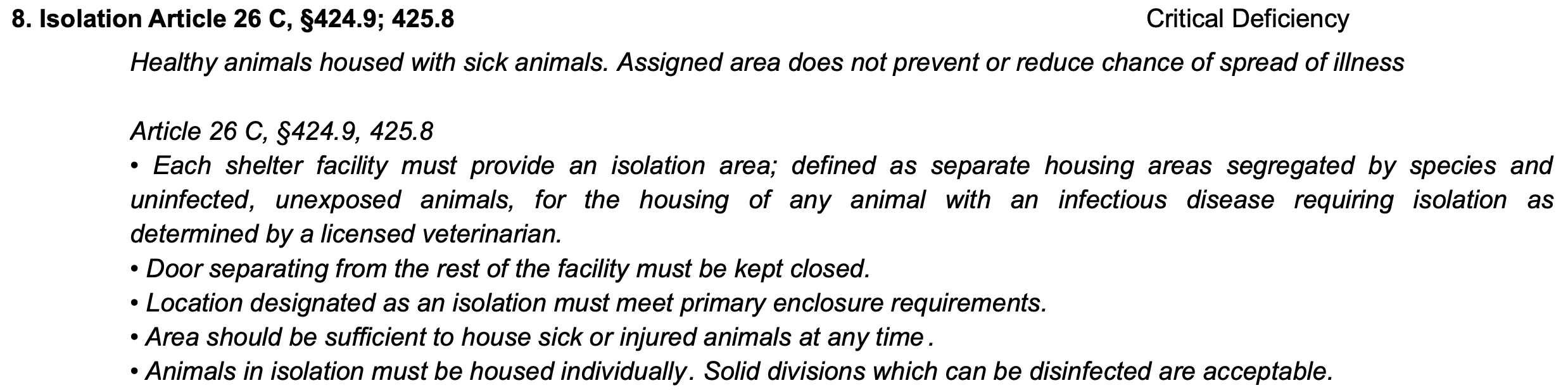
As I reported for Gothamist in 2019, a 2013 probe by then-Manhattan borough president Scott Stringer found animals living in “deplorable conditions” at ACC. The same report said the ASPCA adoption center saw “a nearly 100 percent rate of infection” — preventable respiratory illnesses, for the most part — among cats and dogs received from ACC.
Another Stringer investigation, in 2015, uncovered ACC administering expired medications to animals in its care, and found vaccines stored in refrigerators alongside food, beverages and remains.
It’s unknown whether state inspectors know that sick animals are culled by ACC because they are sick, but it’s not a secret. To acknowledge that, however, the ag department would have to address the everyday mass exterminations of adoptable cats and dogs across the state.
Thanks to the same politicians who approved the new “shelter” standards, New York has no law against taxpayer-funded killings of healthy, adoptable animals for the sake of kill-pound staff convenience.
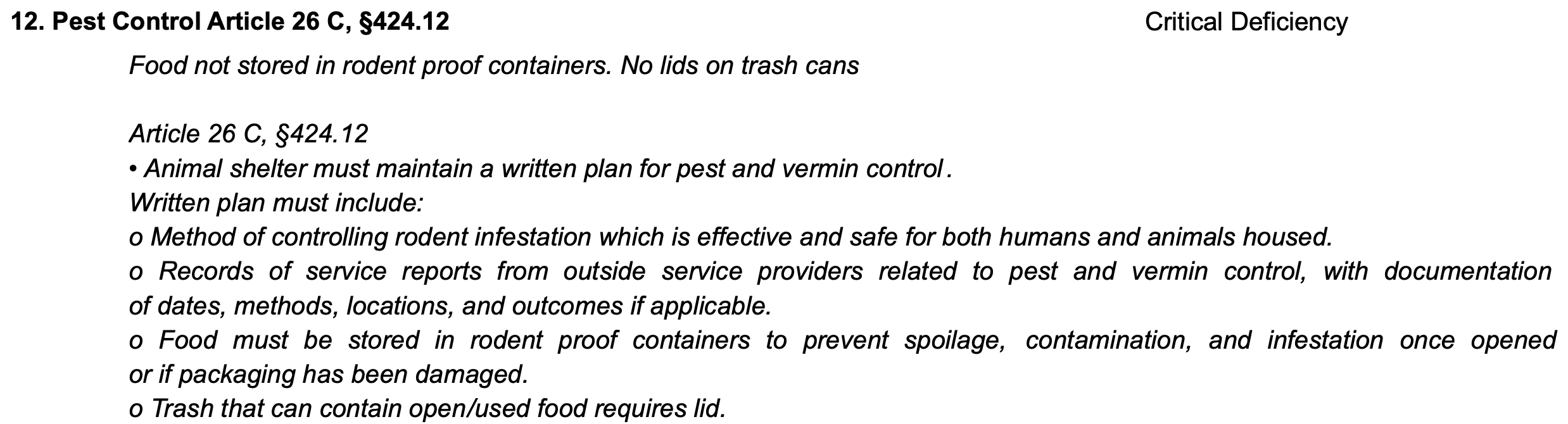
In New York, then, state legislators and bureaucrats who ding kill pounds for open trash cans would have no issue with a terrified whimpering dog being dragged past those receptacles knowing he is about to die.
It’s this brand of logic that gets you a traffic ticket for failing to yield to a child in a crosswalk but no criminal penalty whatsoever for the act of running over and killing the child to whom you failed to yield.

A whelping box, as I learned after looking it up, provides a safe enclosure for pregnant dogs to birth and nurse puppies. The joke is on Albany here. Why bother with such frippery when you can simply exterminate in utero? And if momma dies along with her babies, so much the better.
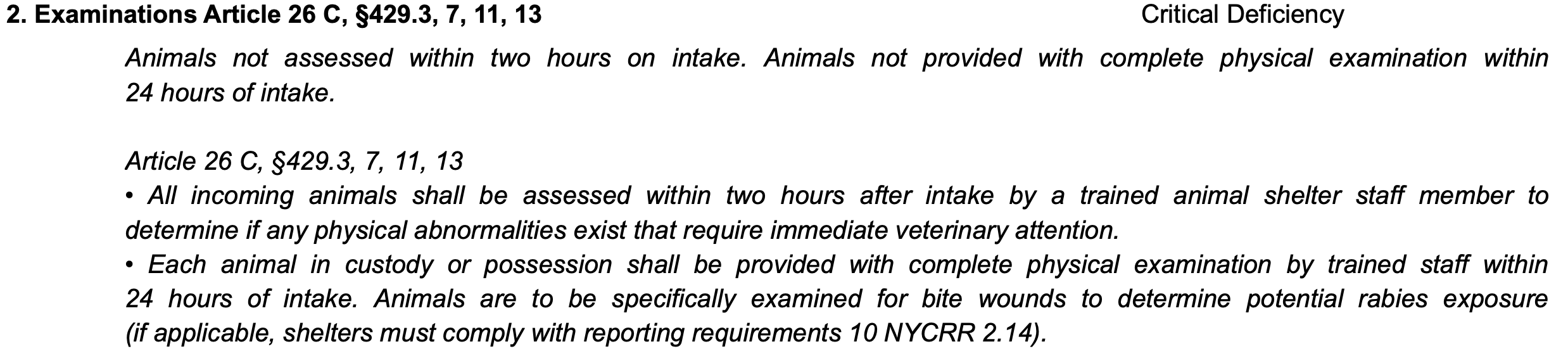

I’m lumping the last two critical deficiencies together because they are of a piece. An organization that kills perfectly healthy animals because it is easier than rehoming — an organization that kills adoptable animals for lulz — is indifferent toward animals. Contemptuous, even.
It’s why inspectors also cited ACC for:
failure to keep the air conditioning in working order;
failure to document (and thereby failure to mitigate) noise levels;
failure to clean and disinfect kennels;
failure to provide adequate housing space;
failure to let cats and dogs out of their cages for a scant 15 to 20 minutes a day (which is all the state requires);
failure to provide enrichment;
failure to properly train staff; and
failure to produce vet-approved protocols for more than a dozen categories — from sanitation to enrichment to “humane euthanasia.”
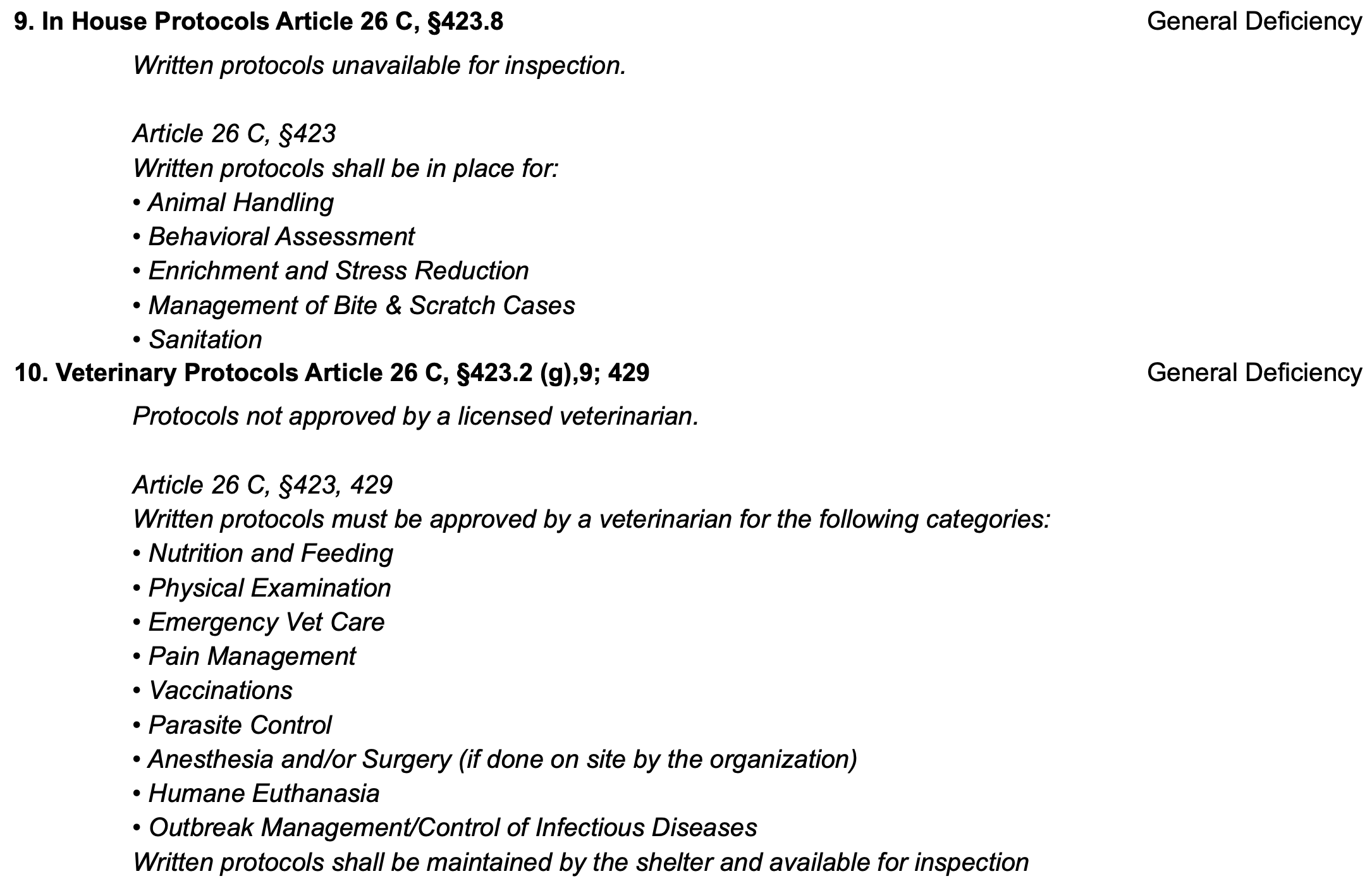
And here’s the kicker: On May 29, state ag department inspectors issued a follow-up report giving ACC perfect marks.
So according to the New York State Department of Agriculture and Markets, ACC in nine days pulled off what it couldn’t do (or had no interest in doing) in three-and-a-half (if not 31) years.
This is the same department, mind, that gave City of Buffalo Animal Shelter a perfect rating two weeks before a TV news crew exposed conditions there so horrid the report was preceded by a viewer discretion advisory.
The Scoop New York queried ACC, DOH, Mayor Mamdani and the state agriculture department concerning the ACC inspections. We asked if inspections were conducted at all three ACC locations, or just one. We asked how animals crammed into inadequate ACC facilities were kept safe. We asked how the state would ensure ACC ends its decades-long practice of housing sick and healthy animals together. We asked how ACC managed to overhaul its operations to achieve total compliance in such a short time.
There were no replies.
OFFICIALS RESPONSIBLE FOR NYC ACC OVERSIGHT
NYS Ag Commissioner Richard Ball: 518-457-2771; Email
Mayor Zohran Mamdani: Contact form
City Council Speaker Julie Menin: 212-788-7210; Email
Council health chair Lynn Schulman: 212-788-6981; Email
Comptroller Mark Levine: 212-669-3916; Contact forms
Public Advocate Jumaane Williams: 212-669-7250; Email
City Council members: Lookup
Borough presidents: BX; BK; MN; SI; QS
NYC DOH Commissioner Alister Martin: 311; Contact form
NYC DOH ACC minder Corinne Schiff: 646-632-6496; Email

Here’s the latest New York companion animal news:
You can love companion animals or you can love watching their adoptive families terrorized by the government, but not both.
Romanch Mahajan, an 18-year-old visiting NYC from India, was killed in a horse carriage collision in Central Park.
Related: Deniz, a 16-year-old horse press-ganged into carriage work, collapsed and died apparently after consuming a plant toxic to horses, for which carriage driver reps at the Transport Workers Union pretty much blamed Central Park. Because of course they did.
Related: “A city-hired veterinarian uncovered concerning conditions inside Central Park’s stables, including cramped quarters, skin lesions and swollen limbs.” Also the park’s doing, surely.
Related: The Saratoga Harness Track barn in which 17 horses died in a fire reportedly “was not equipped with sprinklers or other fire suppression devices.” Meanwhile, the New York State Gaming Commission warns not to confuse its limp perfunctory response with an “investigation.”
Related: 13 Hands Equine Rescue in Dutchess County needs sponsors for 13 horses the rescue took in after the Brooklyn riding academy where they worked went out of business.
If you think “Two new tick species descend on the Hudson Valley and Catskills” sounds scary, try “Rare Lyme disease bacteria found in New York ticks.”
Lollypop Farm in Rochester says it is suspending discounted spay-neuter services for smaller orgs due to a shortage of veterinarians.
Related: Rochester Animal Services is looking to foster and rehome dozens of dogs as the agency prepares for a much-needed renovation.
Upstate shelters and rescues that lack $1B contracts say rules imposed by the aforementioned Companion Animal Care Standards Act will discourage fostering and force many orgs out of existence.
Greenville said it had to shut down a dog park because people refused to clean up after their dogs.
Finally: The adventures of an “itinerant cat tutor” and their ridiculously charming pupils.

From NYC ACC KILLS


Food recalls
FDA announced one pet food recall this week:
Breeder’s Edge, Shelter’s Choice / Revival Animal Health Canine Milk Replacer [variable levels of Vitamin D]
Check here for more info on FDA-announced recalls, and here for details on prior FDA advisories and outbreaks.